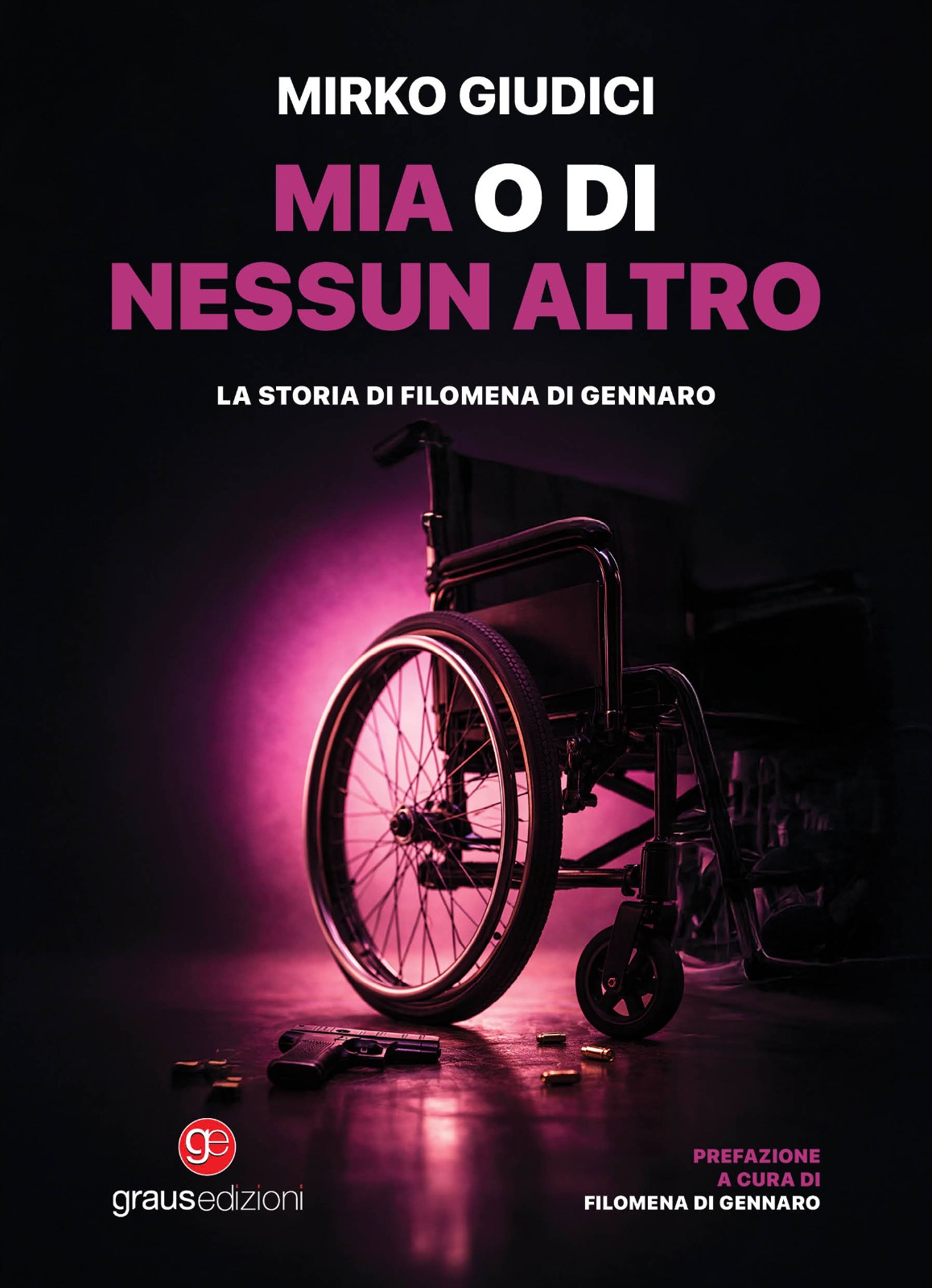
There is a sentence that cuts through the history of Filomena Di Gennaro and which today lends its title to the book that tells its story: "Mine or No One Else." The brutal synthesis of a culture of possession that still fuels gender violence today and which finds its most extreme expression in control and the denial of autonomy.
The book Mine or no one else's, written by the journalist and writer Mirko Giudici and published by Graus Editions, tells an individual story, but above all, sheds light on a collective phenomenon that also affects Italian communities abroad, where the issue of gender violence often remains submerged amid isolation and difficulty accessing services.
A universal story
Filomena was born and raised in Puglia, specifically in Stornarella. A determined young woman, she earned a degree in psychology and achieved one of her biggest dreams: joining the Carabinieri. In 2005, she won the competitive exam and began training to become a marshal.
After ten years of relationship, Milena decides to leave her partner, Marcello Monaco. A decision that, in a culture still marked by patriarchal models, he perceives as an intolerable affront.
When violence becomes systemic
January 13, 2006, marked an irreversible rift. Monaco traveled hundreds of kilometers armed, with the clear intent of killing.
What's striking, in the reconstruction, is not only the brutality of the act, the shots fired at close range, the repetition of the violence, but its predictability. The signs were there: the obsessiveness, the pressure, the inability to accept the end of the relationship. These are elements that today, in prevention work, we recognize as risk indicators.
Milena managed to save herself thanks to the presence of the lieutenant, who intervened and stopped the attacker, but she was left with a permanent disability. She has been confined to a wheelchair since 2006.
From victim to political subject
It is here that her story stops being just a news story and becomes an active testimony. Milena rejects the passive narrative of the "victim" and chooses to expose herself firsthand, transforming her experience into a tool for awareness and change.
This is how the Milena Project, also supported thanks to the work of Mirko Giudici, through which Filomena Di Gennaro brings her story directly to schools. The story of her experiences becomes a concrete means of raising awareness among young people about gender violence, helping them recognize the early signs of toxic relationships, deconstruct stereotypes, and understand the importance of asking for help.
In collaboration with the SIM Carabienieri (Italian Carabinieri Military Union), these meetings are designed as spaces for critical education. Filomena's testimony is not presented as a story in itself, but as a key to understanding relational dynamics that are often normalized, such as control, emotional dependence, and jealousy mistaken for love.
Intervening in contexts where identities and imagery are formed, such as school, means addressing the invisible terrain where stereotypes and behavior patterns take root. It's there that we can truly make an impact, providing interpretive tools rather than defensive ones.
The value of the story
From an editorial point of view, Mine or no one else's It is part of that narrative production that combines journalism and civic engagement. Giudici chooses an accessible but never superficial register, leaving room for Milena's voice without giving in to the sensationalization of pain.
The book's main merit is precisely this: avoiding the trap of "trauma pornography." A book that shows how violence is not an isolated event, but the result of a cultural system. It depicts an Italy that is not only one of roots and traditions, but also one of contradictions and civil struggles.
The message that emerges from Milena's story is clear and radical: violence against women is not a women's problem. It is a social, cultural, and political problem. It concerns everyone. It concerns men, who are called to question models of toxic masculinity. It concerns institutions, which must guarantee real and timely protection. It concerns communities where silence can become complicity.
Filomena Di Gennaro's story is a call to responsibility and through Mine or no one else's remember, forcefully, that love can never coincide with possession.