From a descent into hell to a confrontation with Frank Lloyd Wright's Solomon R. Guggenheim Museum, the Chiaia–Monte di Dio station transforms the journey into an architectural experience that crosses the Atlantic.
Naples descends into art to rise again as a city
There are infrastructures that simply solve problems. And then there are others that disrupt the automatic flow of traffic and transform it into an experience. The Chiaia–Monte di Dio station on Line 6 of the Naples Metro, designed by the renowned architect Uberto Siola with the contribution of the British director, screenwriter, editor, painter and writer Peter Greenaway, belongs to the second category: it does not only transport bodies, but constructs meaning.
Technique and vision
More than thirty meters beneath a fragile urban fabric, the station is an exercise in engineering precision: deep excavations, advanced consolidation, and continuous monitoring of the subsoil. But the technology here is invisible: it supports a vision. The descent is not just function, it's story.
The Descent into Hades
Siola called it a descent into Hades. And the metaphor becomes space: at the entrance we find Jupiter, as protector of travellers, present in the form of a metal sculpture painted blue, with twenty-four arms reaching towards the sky, a metaphor for the passage of time, while mythological figures emerge along the way: Neptune, Ceres, Proserpina and Pluto. It's a symbolic journey, combining rationalism and esoteric tension, to the point of evoking the imagery of Raimondo di Sangro. Two souls of Naples that don't cancel each other out here, but coexist.
Block architecture
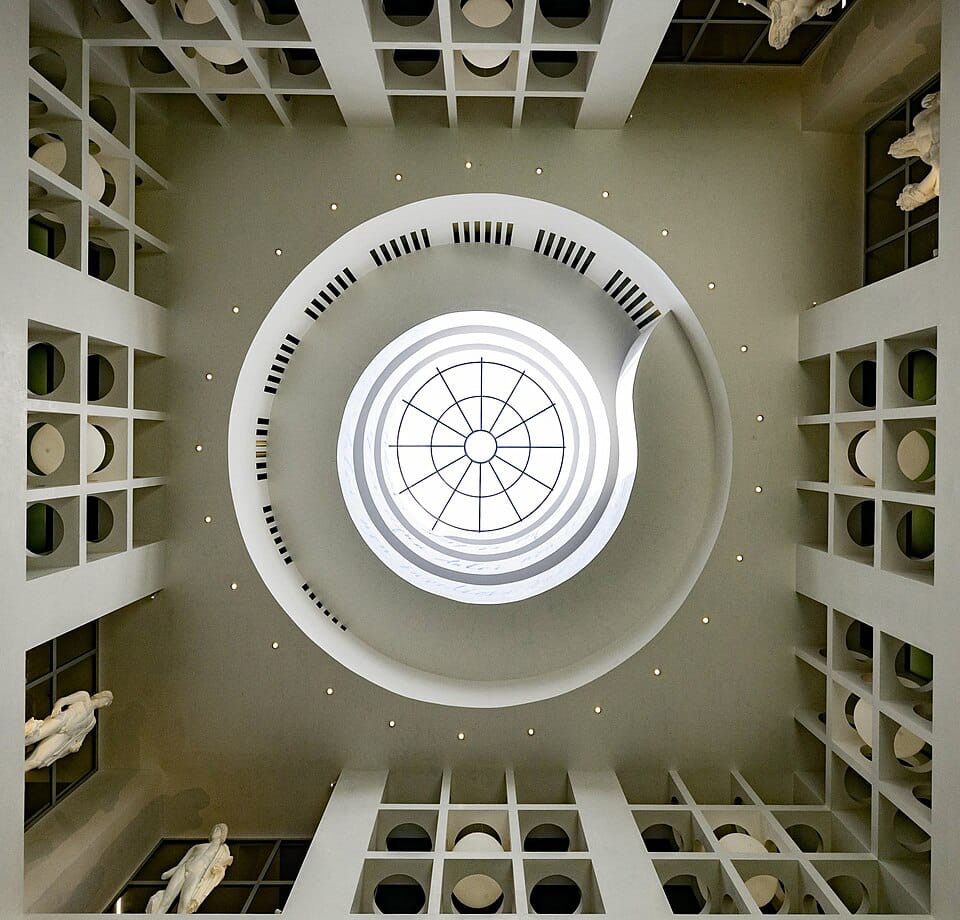
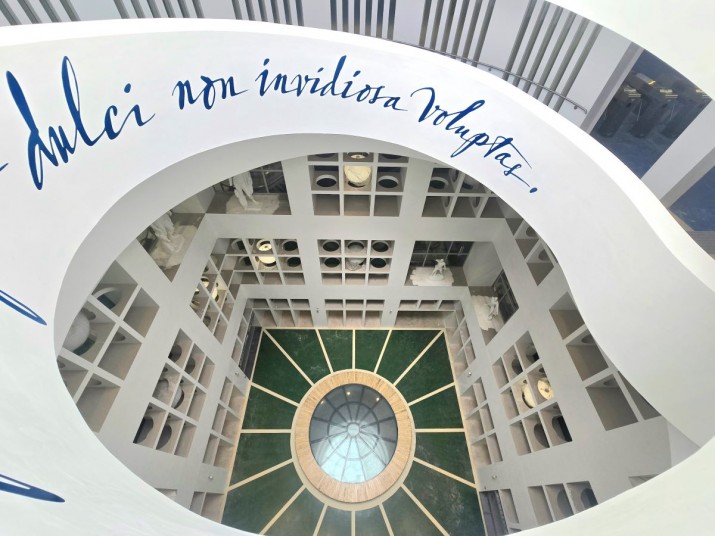
The station is constructed as a sequence: not a single space, but a vertical progression. After the upper threshold, a lower space opens up, a large cylindrical well twelve meters in diameter, dedicated to Neptune and characterized by the colors white and blue. It is a space traversed by a spiral staircase, where the light channeled by the dome guides the gaze and the body. On the parapet, like a theoretical seal, a verse from Ovid can be read: It is in fresh water not envious voluptas. It's not a decoration, but a statement: the pleasure of water—and movement—is shared, not competitive, and refreshing.
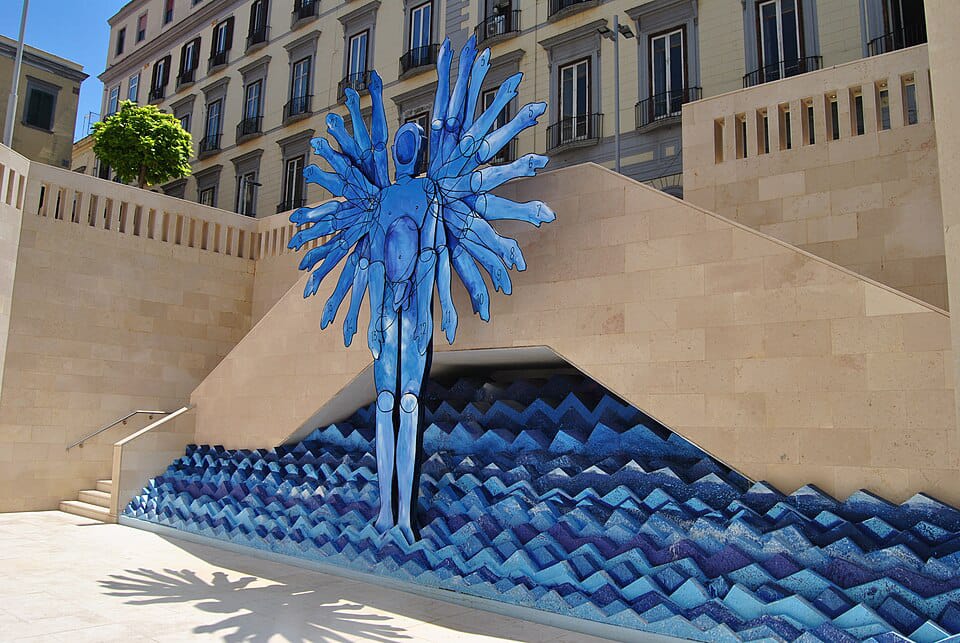
The upper entrance to Santa Maria degli Angeli with the statue of Jupiter
At this same point, traces of the ancient Roman Serino aqueduct, the blue gold of ancient history, also emerge, creating a physical continuity between the descent and the stratification of the city.
Further down, the level connected to the entrance on Via Chiaia, dedicated to Ceres and dominated by the green, It is structured as a square matrix: a grid that hosts monumental reproductions of the Farnese collection of the National Archaeological Museum of Naples. Archaeology thus becomes an integral part of daily life and evokes the treasures of the Neapolitan city.
The dock plan
Follow the level ocher, dedicated to Proserpina, in an evocative atmosphere, evoked through six pomegranates: symbol of passage and return, of the threshold between worlds.
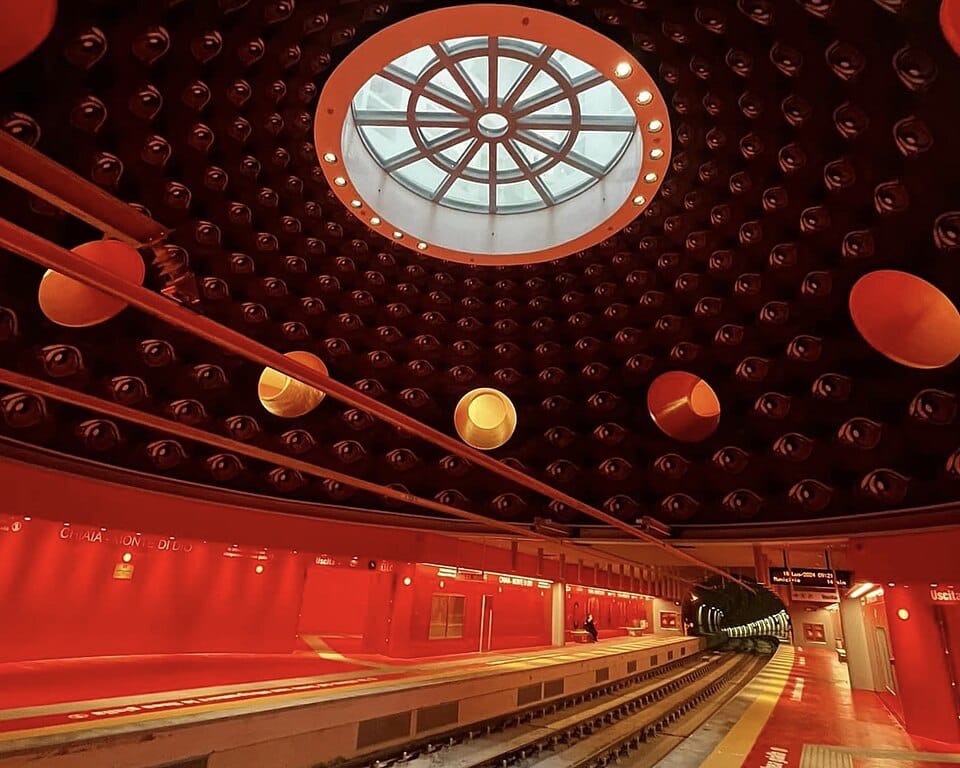
Finally, the iron plan. Red, Deep, dedicated to the descent into Hades. Here, a steel dome, hollow at the center, lets light filter in from above and is dotted with 320 orange eyes: the gaze of the Lord of the Underworld on the waiting travelers. Two passing tracks run side by side with platforms that complete a space that is both technical and symbolic.
Blue at the top, green in the center, red at the bottom: a catabasis, evoked by a deep underground structure that connects the hilly areas (the Monte di Dio) to the coastal areas (Chiaia). A vertical succession of colors interprets the significant difference in altitude as a mythological descent, almost as if to create a bridge between land and sea, a connection between history and nature. Flow engineering thus becomes a perceptual construct.
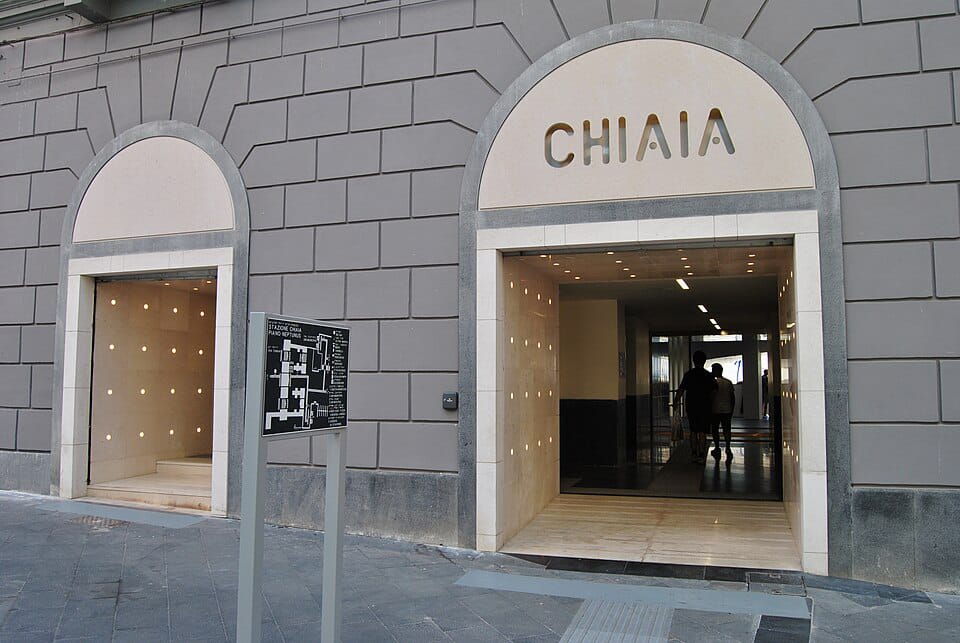
The lower entrance on Via Chiaia
Biography and responsibilities
This approach is no coincidence. Uberto Siola was a professor and dean at the Federico II University, a scholar of the city and a longtime active participant in public debate. His architecture stems from a precise conviction: public space is a civil, rather than a technical, issue.
A long but accomplished work
From 1999 to completion in 2024, over twenty years of work. A long period that doesn't dilute the idea, but rather tests it until it is confirmed. The result is unmistakable: beauty not as ornament, but as an element of collective discipline.
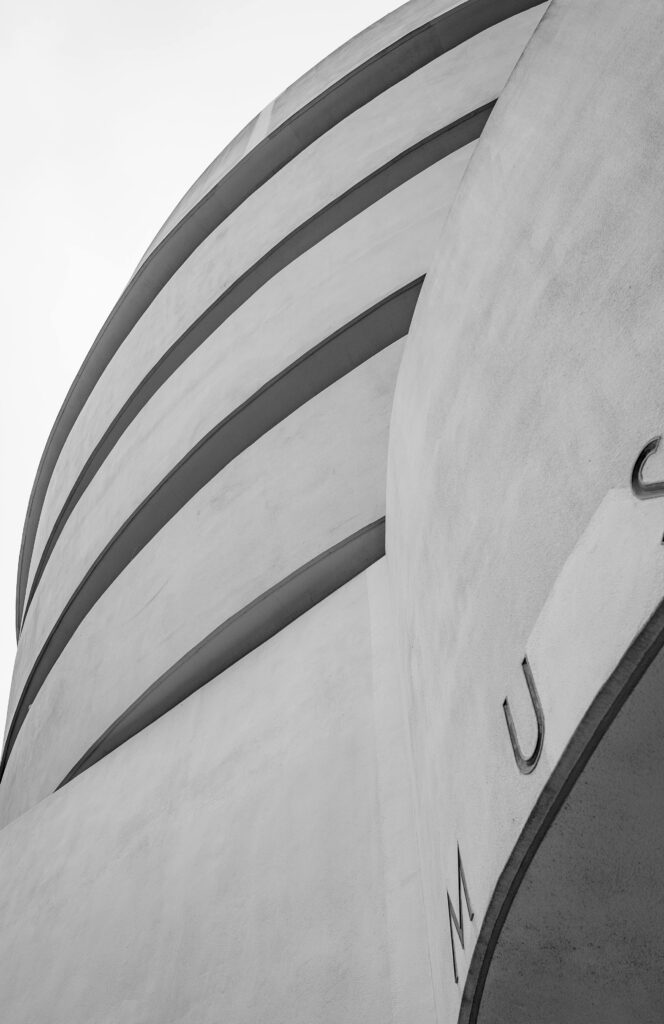
Guggenheim Museum, New York
The cone, the spiral, the Atlantic
It is in the very form of the station that the discourse broadens and becomes international. The large cone of descent designed by Siola opens an implicit dialogue with the Solomon R. Guggenheim Museum by Frank Lloyd Wright.
The Guggenheim is a declaration of principle: architecture as a continuous, fluid organism, capable of guiding the visitor through a single spatial experience. The famous spiral ramp is not just a distribution solution. It is a vision of the world: space that unfolds seamlessly, enveloping and orienting visitors.
Siola works in the opposite direction, but with the same conceptual intensity. Where Wright builds a climb, Siola organizes a descent. Where New York It offers a spiral that opens upward, while Naples carves a cone that leads downward. But the principle remains the same: eliminate fragmentation, transform the journey into a unified experience.
The Chiaia–Monte di Dio cone is, in this sense, a Mediterranean response to American organicism. It doesn't imitate it, it translates it. It doesn't replicate its form, but rather takes on its logic and invents a new approach. Passengers don't pass through separate environments, but are enveloped in a spatial continuum that accompanies them, orients them, and forces them to become aware of their own movement.
It's a decisive step. Because it shifts the subway from the realm of engineering to that of culture. Just as the Guggenheim redefined the museum, the Siola station has transformed a’ the’infrastructure as a vehicle of meaning. No longer a neutral space, but an active device.
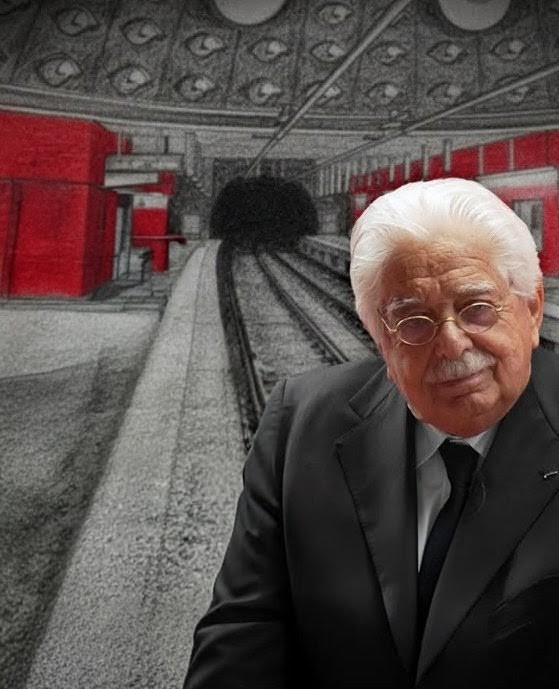
The architect Uberto Siola
A bridge between Naples and New York
Here, the bridge between Naples and the United States becomes concrete. It's not a learned quote, but a structural connection. Frank Lloyd Wright and Uberto Siola share a clear idea: architecture must guide the body to shape the mind. It must build and create experience, not just contain functions.
And yet, the difference remains fundamental. The Guggenheim is an icon, an autonomous object that imposes itself on the city, characterizing it. The Neapolitan station, on the other hand, is immersed in everyday life and its millennia-old history. It isn't visited: it's used. It isn't contemplated: it's passed through.
It is precisely here that the project acquires political force, in the highest sense of the word. Bringing such a demanding idea into the urban routine means raising the cultural level of collective life. It means demonstrating that even the most banal gesture—taking the subway—can become a quality experience.
This is the heart of the story. Because in that cone descending into the Naples underground and in that white ribbon winding upward toward the New York sky, we recognize a common ambition: to use architecture to offer new ways of inhabiting the world.
Two distant cities, two opposing movements, a single idea. And, in between, the Atlantic as a space of connection, not distance.
The unifying architecture of worlds
Concluding this journey between Naples and New York, between depth and ascent, is a simple realization: architecture, when conceived, does not separate functions but unifies them; it does not divide worlds but connects them. It is in this shared space, between engineering and imagination, between infrastructure and the search for new living spaces, that the value of a public work—a synthesis of engineering, art, and architecture—is measured, capable of speaking to the world through its universal language, acting as a bridge between cultures, conveying values, history, and beauty without the need for words.